

Written by Mattia Gottardello – Full-stack Developer in AzzurroDigitale
In the previous episode — “Beyond the Hype” — we stripped away the mystique surrounding LLMs: they are not oracles, but statistical engines that predict the next word. Good. Now that we understand what an LLM is, we need to learn how to guide it. Because the difference between a mediocre response and an output that saves you two hours of work doesn’t lie in the model itself: it lies in how you ask.
Business Case: Understanding the Value for Companies
Prompt Engineering is not black magic — it’s process optimization. The same technology can produce radically different results depending on how the request is structured.
A poorly written prompt is like assigning a task to an intern on their first day with zero context: you end up with generic, off-tone text that has to be rewritten from scratch.
A well-structured prompt is like working with a senior colleague: they receive the instructions, understand the context, and deliver something usable on the first try.
Translated into concrete business terms:
- Sales emails that match your tone of voice instead of sounding robotic.
- Reports and document summaries already formatted according to your internal standards, without manual rework.
- Consistent outputs at scale, independent of daily mood swings or rushed execution.
The ROI is easy to calculate: less time spent correcting, more time spent making decisions.
How It Works: Simplifying Complexity
Let’s take a common daily task: writing an email to a customer about a delivery delay.
Bad Prompt (lazy zero-shot)

Result: an anonymous, overly formal text written in stereotypical corporate English, signed “The Team.” Completely unusable.
Proper Prompt (structured)

Same model, completely different outcome.
The rule is simple: give the AI the same context you would give a human being. Role, objective, constraints, output format. If omitting a detail would confuse a colleague, it will confuse the model too.
Deep Tech: Technical Insights and Best Practices
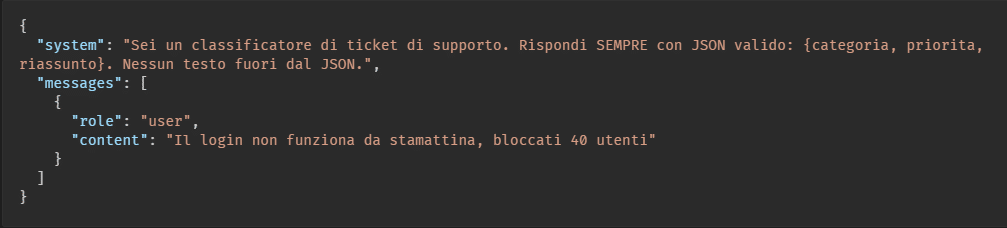
When moving from chat interfaces to API integrations, the game changes. The first key distinction is architectural:
- System Prompt — The persistent “rules of engagement” for the agent: who it is, what it can and cannot do, and the required response format. Defined once.
- User Prompt — la richiesta puntuale dell’utente finale, variabile ad ogni chiamata.
Two techniques I use daily in producion:
Few-Shot Prompting — Include 2–3 input/output examples directly in the payload. The model learns the pattern far better than through abstract descriptions alone. This is essential for custom taxonomies, structured data extraction, domain-specific classifications.
Chain-of-Thought — Force the model to reason before answering. Typical instruction: “Analyze the steps in a reasoning field, then return the final result in output.” This drastically reduces hallucinations in logical tasks, at the cost of a few extra tokens. When the output must be JSON consumed by other code, this pattern often makes the difference between a reliable integration and a production bug at 3 a.m.
Conclusion and Next Episode
Today, the best code is no longer made only of Python, TypeScript, or Go: it also includes well-engineered natural language instructions. Treat prompts the same way you treat code: version them, test them, document them.
Next Episode — “LLMs in Production: Costs, Security, and Integration” — how to deploy these models in enterprise environments without exploding the budget or risking data leaks. We’ll cover: token economics, RAG architectures, self-hosting, privacy and security Stay tuned.
By the way, what do you think of this translation style? Do you prefer something more technical and corporate, or more editorial and punchy like a magazine article?