

Article by Gaia Pistori – Full-stack Developer at AzzurroDigitale
REST APIs are the invisible engine that allows software, management systems, and applications to communicate with each other. In this article, we clearly explain what they are, how they work, and why they are a strategic asset for companies looking to integrate systems, scale, and accelerate digital transformation.
Every day we use dozens of applications that “magically” communicate with each other, allowing us to request, send, or delete data: the app that shows the weather, the website that lets us pay by card, the management system that retrieves customer data. Behind the scenes, very often, there’s one key player: the REST API.
Why REST APIs are essential (even if we don’t see them)
From the perspective of a customer or end user, REST APIs serve a very simple purpose: to enable different systems to communicate reliably, quickly, and in a standardized way.
Some concrete examples:
- A mobile app that displays your account data
- An e-shop that shows you the stock of a specific product
- A management system that synchronizes customers and orders
- An app that retrieves notifications, messages, or updated content
In practice, every time an app “requests” something from another system and receives a response, it is likely using a REST API.
What is an API?
API stands for Application Programming Interface, which is a set of procedures that allows multiple services and applications to communicate with each other.
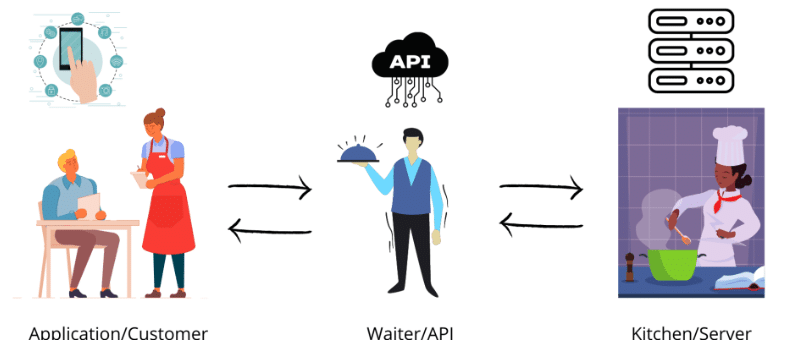
The classic metaphor to represent this mechanism is a restaurant:
- The diner is like the user of our application
- The kitchen is the system that manages the data
- The API is the waiter
- The menu is the list of possible requests
The customer cannot enter the kitchen to cook; to get their dish, they must place an order with the waiter, who will prepare it and bring it if it’s available on the menu.
What is REST?
REST is not a technology, but a style that defines a set of rules for building these APIs and handling user requests
REST defines a set of constraints, namely:
- Every resource is unique and can be identified through an address (URL)
- There is a finite and well-defined set of possible requests that return responses in a standard format.
- There are two types of roles: the client (user side), which handles the graphical interface, sending requests, and receiving responses; and the server, which handles the processing.
This way, everyone shares the same language and the same rules.
What is a REST API?
Putting the pieces together: a REST API is a standard, organized, and readable way for different applications to communicate over the internet through a set of defined and standardized requests.
Deep Tech for Insiders
From a technical perspective, a REST API:
- Uses HTTP, the same protocol used when we open a website in a browser.
- It exposes resources through unique URLs that identify and allow access to specific data. For example:
/users-> returns the list of all users/users/54-> returns the user with ID 54
- It is stateless: each request is independent, and the system does not retain memory of previous or subsequent events, allowing the request to be processed without considering prior outcomes.
- It returns data in a standard format, usually JSON: a highly readable and easy-to-interpret format. Here is an example of a user object in JSON:
{
  "id": 54,
  "name": "Mario Rossi",
  "email": "mario.rossi@email.it"
}- It also communicates the status of the operation through HTTP status codes, which indicate the result of the request and make it easy to identify the outcome and any possible reason for failure. The most common codes are:
200 OK→ all good201 Created→ resource created400 Bad Request→ wrong request401 Unauthorized→ you are not authorized to perform the requested operation404 Not Found→ resource not found500 Internal Server Error→ something went wrong on the server
- And how can we specify what we want to request? We use HTTP verbs:
GET: obtain data→ read-only action, with no impact on the dataPOST: build a new resource → creates a new element in the systemPATCH: modify an existing resource → modifies an existing element in the systemDELETE: delete an existing resource → removes an element from the system
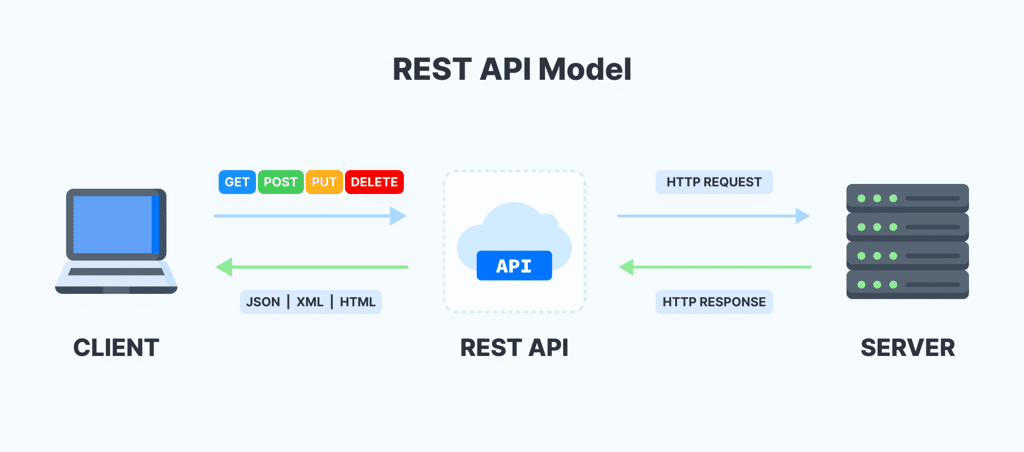
This standardization is the reason why the graphical interface (frontend) and data processing (backend) can be developed separately and reused independently, allowing us to have applications that are more scalable and easier to maintain and expand.