

Article by Nicola Boscaro – Full-stack Developer at AzzurroDigitale
Explore how MVC and DDD, two different design patterns, both pursue the goal of creating robust and scalable web applications, adapting to different needs and complexities.
MVC (Model-View-Controller) and DDD (Domain-Driven Design) are two software design approaches that help companies build robust web applications. The main difference lies in how they address complexity: MVC simplifies the management of the user interface and logic, while DDD focuses on business processes and their digital representation.
When to use MVC
MVC is particularly well suited to front-end development, especially with frameworks such as Angular. Thanks to its modular structure and clear separation between Model, View and Controller, MVC facilitates the creation of responsive, maintainable and scalable user interfaces, accelerating development and improving code readability at the UI level.
When DDD is needed
DDD addresses the backend, where the complexity of business processes, typical of sectors such as manufacturing, requires accurate domain modelling and a clear definition of boundaries between parts of the system (‘bounded contexts’). DDD helps translate business requirements into consistent code, improving cooperation between developers and domain experts, and facilitates the transformation of monolithic systems into microservices.
Microservices: the turning point for the ‘big players’
If the project grows or needs to adapt (e.g., many business divisions, product expansion), DDD is (almost) mandatory to achieve microservice architectures. Each “service” can represent a piece of business, be adapted/scaled separately, and communicate with other services.
How It Works: Simplifying Complexity
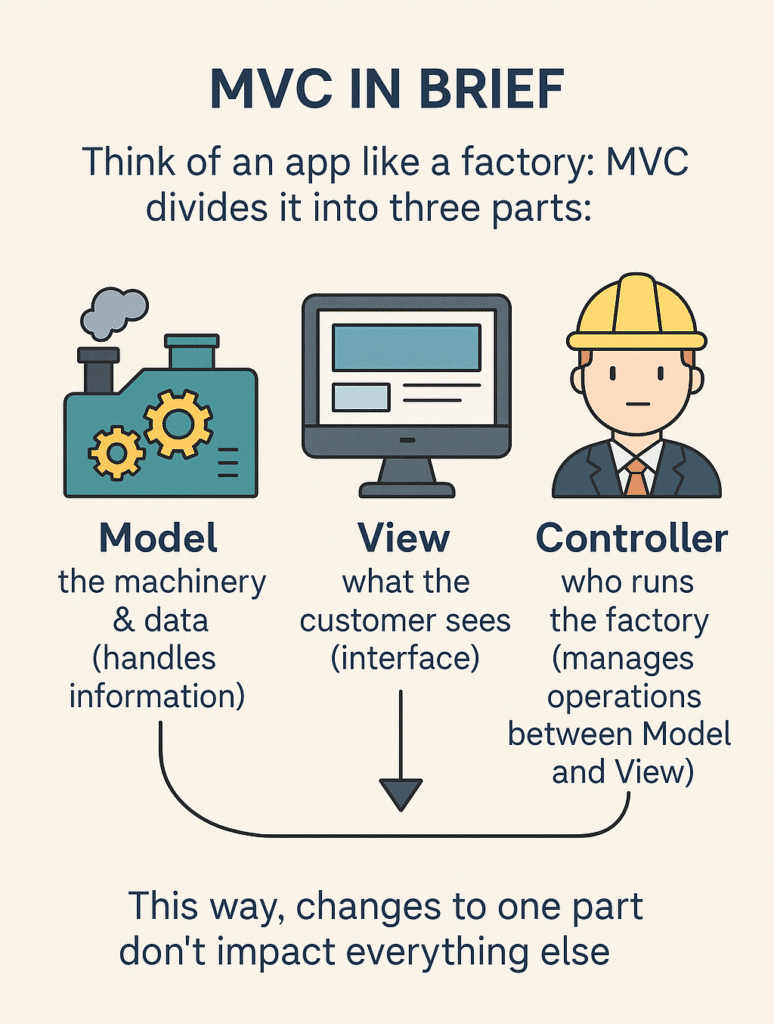
MVC in brief
Imagine an app as a factory: MVC divides it into three departments:
- Model: machinery and data (information management)
- View: what the customer sees (interface)
- Controller: who runs the factory (manages operations between Model and View)
This way, any change to one part does not affect the rest.
MVC
DDD in brief
DDD, on the other hand, builds software around what the company does. An example in manufacturing: if production is the heart of the business, DDD helps to represent it in the software with the logic that is really needed, keeping the different processes separate (“bounded contexts”).

DDD
For those new to microservices
When a project needs to evolve into microservices, DDD helps to “slice the system”, assigning each strong service a specific “context” and business logic, while MVC helps to structure the interface of each service.
Deep Tech for Insiders
Pros and cons of MVC
- Separation of duties: With Angular and other modern frameworks, the MVC pattern allows for a clear separation of presentation, logic, and data sources. This facilitates testability and maintainability, speeds up the development of new features, and allows large teams to work in parallel without generating conflicts.
- Easy onboarding: the familiar structure of the pattern speeds up the integration of new developers, who can immediately identify where to intervene within the UI modules or services.
- Limitations: In projects with highly complex logic, MVC risks becoming cumbersome. Applying the pattern in contexts where the business logic is intricate can lead to over-engineering of the UI and an increase in redundant code.
Practical example: Imagine a detailed page in a complex back office, containing several tabs, each with different information and interaction logic. Thanks to the MVC architecture, each part of the interface is managed by independent components, which can be developed, tested and maintained separately.
In this context:
- The main component controls navigation between the various tabs: it monitors which tab is active and manages smooth transitions between screens, maintaining consistent navigation status.
- For each tab, there is a dedicated component that handles specific logic, such as data saving, form validation, and event emission (emitter) to communicate changes to the main component or other affected components.
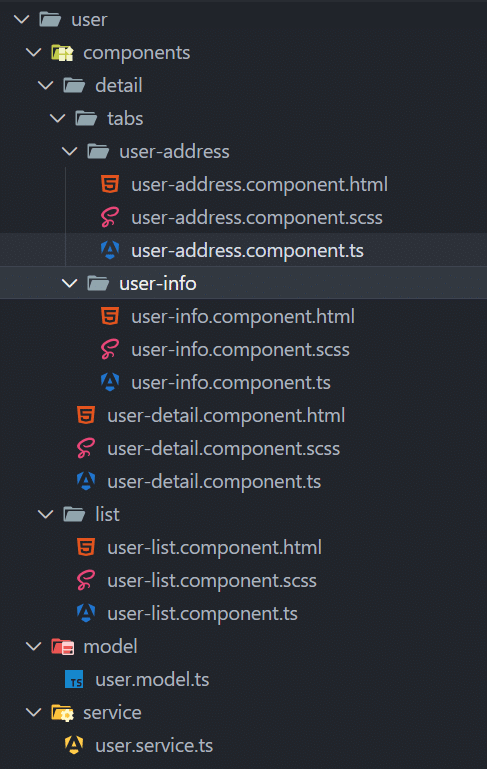
This separation not only makes the code more modular and reusable, but also improves the development experience by allowing complexity to be isolated and managed precisely, minimising side effects between different features.
Pros and cons of DDD
- Perfect for complex systems: Domain-Driven Design allows you to model business processes and rules so that software abstractions truly reflect the business domain. It is not just a technique, but a way of thinking and a set of design priorities designed to accelerate development in highly complex contexts [1].
- Evolution and scalability management: DDD encourages designing parts of the system to reflect the domain model in a clear and direct manner, so that the correspondence between code and real concepts is immediate. Tools such as bounded context, aggregate and repository help separate responsibilities, rules and services, naturally facilitating any evolution towards microservice architectures.
- Limitations: This approach requires constant collaboration with the business and longer analysis and design times. Furthermore, it does not bring significant benefits when the complexity of the domain is low or when requirements change very quickly.
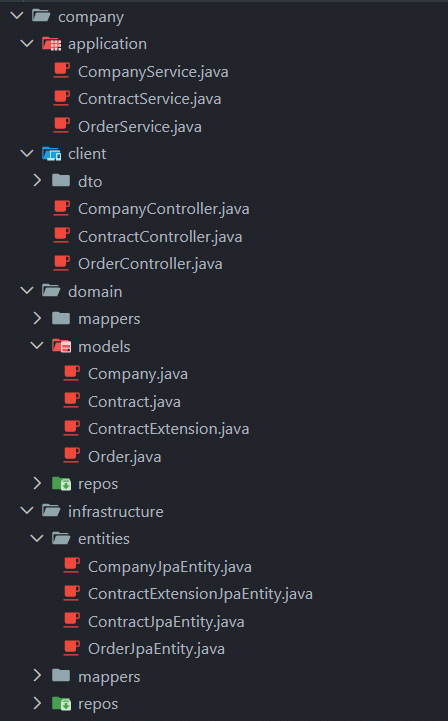
Practical example: Creating backend logic for order management in manufacturing: using DDD, bounded contexts can map processes such as creating a contract for a customer and opening an order linked to that contract. Each context evolves independently, reflecting the business reality and exposing dedicated APIs for the frontend, which instead uses MVC/Angular to display, for example, a filtered list.
DDD In AzzurroDigitale
In our experience at AzzurroDigitale, although Domain-Driven Design was not initially the predominant architectural model, in recent years we have progressively embraced this methodology as a pillar for managing the growing complexity of our projects. Today, DDD is our preferred choice, especially in contexts where the application must support multiple tenants, each with specific needs, and where product modularisation and scalability are essential requirements.
By adopting DDD, we were able to effectively segment the code into highly specialised modules, each responsible for a well-defined portion of the domain logic, thus clearly separating the business logic from the rest of the application. This clear separation allowed us to delegate and isolate complexity within dedicated modules, facilitating maintainability, independent evolution, and the ability to extend or customise individual components without impacting the system as a whole.
This strategy integrates perfectly with the requirements of microservice or modular architectures, where each component is autonomous and communicates with others via well-defined interfaces, while ensuring internal cohesion and overall flexibility. As Eric Evans points out in his book Domain-Driven Design: Tackling Complexity in the Heart of Software, “The heart of software is the ability to solve domain-related problems for the user”, and it is precisely this heart that we wanted to place at the centre of all our solutions, ensuring that the code faithfully reflects the real complexities of the business and is not limited to a simple technical implementation.
References
[1]: Evans, E. (2003). Domain-driven design: Tackling complexity in the heart of software. Addison-Wesley Educational.