

Article by Dario De Giovanni – Full-stack Developer at AzzurroDigitale
A journey into the world of AI Agents: discover how artificial intelligence no longer simply responds, but takes concrete action, automating processes and activities within companies.
In previous episodes, we dismantled the LLM engine, saw how to structure reliable and repeatable prompts, and understood how to bring a model to production while managing costs, security, and integration. We’ve essentially built an extraordinarily capable artificial brain. But a brain without hands can’t change the world. Today, we’re taking the final leap: giving AI the ability to act.
The Monday morning report, automated
Every Monday morning, in thousands of companies, someone opens three different dashboards, copies numbers into an Excel spreadsheet, writes a summary email, and sends it to management. It takes 45 minutes. Every week. 52 times a year.
A dedicated monitoring AI Agent does this — and much more:
- Aggregates data from Analytics, CRM, e-commerce platform and advertising tools
- Detects anomalies and significant changes compared to the previous week
- Put the numbers into context (e.g., “The 12% drop in conversions coincides with Thursday’s deployment update.”)
- Generate a structured report, with graphs and executive commentary
- Email everything every Monday at 8:00 AM, before anyone gets to the office.
Zero supervision required. Zero risk: the agent reads data, not modifies it. The value isn’t just the time saved—it’s the quality and consistency of the information that reaches management every week, without depending on who was sick or otherwise busy.
This is the shift from operational assistance to autonomous execution: not a chatbot telling you how to do things, but a system that does them.
A manager and his team of tools
Think of the AI Agent as a demanding manager with a team of specialists.
The LLM is the manager: he thinks, plans, and delegates. But he can’t open a dashboard, query a database, or send an email alone. To do that, he needs his “employees“: the Tools.
The work cycle is elegant in its simplicity:
- Thinking → The model receives a goal and plans the necessary steps
- Action → Call a tool: “Retrieve sales data for the last 7 days”
- Observation → Reads the result and decides the next step
- Repeat until the task is completed
Tools can be anything:Query su database, Chiama API, Genera grafico, Invia Email, Cerca su Web. Every company has its own toolbox — the Agent learns to use them all.
Deep Tech: Technical Insights and Best Practices
The mechanism that makes all this possible is called Function Calling.
Provide the model with a set of JSON schemas describing the available functions—name, description, and expected parameters. The model, during reasoning, automatically decides which function to invoke and with which arguments:
json
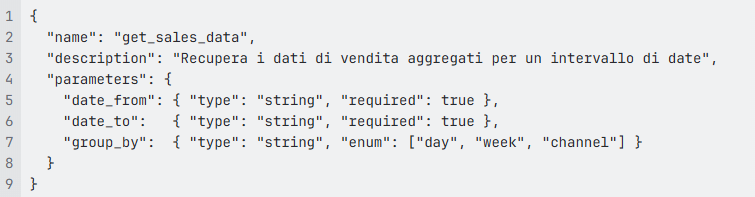
GPT-4, Claude, Gemini—all frontier models natively support this pattern. Your backend handles the actual execution; the model handles the decision logic.
To orchestrate complex, multi-step flows, frameworks like LangGraph or CrewAI allow you to model the entire cycle as a state machine, with conditional nodes, error handling, and persistent memory between sessions. This is essential for agents that need to run reliably in production, not just in demos.
And the golden rule remains valid here: Human-in-the-loop for everything irreversible. A reporting agent can run completely autonomously precisely because it operates read-only. But an agent that modifies data, moves budgets, or sends communications to real customers must always include a human confirmation checkpoint before critical actions. This isn’t a limitation: it’s what makes a system reliable enough to be used in production.
The future is here. Are you ready to build it?
We’ve reached the end of this miniseries. We’ve walked through the LLM revolution together: from understanding patterns, to the art of prompting, to production deployment, all the way to Autonomous Agents.
The message is simple: the true value of AI lies not in the magic of the model, but in the ability to integrate it into real systems. This is precisely the province of Full Stack Developers—those who understand both code and business, both APIs and business processes.
🚀 Want to bring the first AI Agent into your company?
Our team is available for a consultation or a customized solution: we’ll start with a real-world process of your operations, identify the point of maximum impact, and together we’ll build an agent that works for you from day one.
Contact us today — the step from “AI that responds” to “AI that acts” is closer than you think.
Have you read the entire series? Share it with anyone on your team who’s still deciding whether “this AI thing” is worth the investment. The answer, you know by now, is yes.