

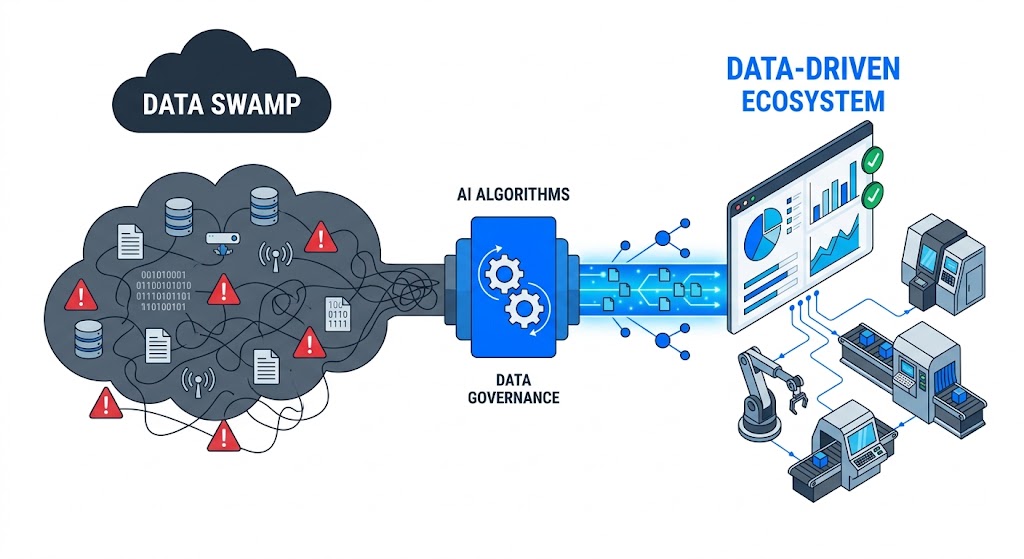
The uncontrolled accumulation of metrics without an operational strategy creates the “Data Swamp,” the data swamp that paralyzes many Industry 4.0 companies. In this article, we analyze how to structure governance and AI to transform raw data into highly strategic decisions for production.
The promise of Industry 4.0 has been clear from the beginning: connecting machines, installing IoT sensors on PLCs, collecting every single bit of information generated by the lines, and transforming the factory into an information goldmine. Many manufacturing companies have invested significant budgets to digitize their plants and meet the technological requirements for interconnection.
However, the operational reality of many companies paints a different picture. Instead of a clean and structured gold mine, we find ourselves immersed in a veritable data swamp: a chaotic, fragmented, and uncontextualized accumulation of millions of raw data points that no one knows how to interpret, analyze, or leverage in their daily work.
What is Data Swamp and how to recognize it in the factory
A data lake is a centralized repository designed to host structured and unstructured data ready for processing. A data swamp, on the other hand, is a degeneration of this system: it occurs when information is dumped into databases without a clear governance strategy, adequate metadata, and a direct connection to the operational needs of plant managers, maintenance personnel, and line operators.
The main symptoms of Data Swamp in an industrial context include:
- Information silos: MES data doesn’t communicate with the company’s ERP or quality tracking systems.
- Lack of contextualization: The temperature of an engine is monitored every second, but the data is not associated with the batch code being processed or the operator on duty.
- Useless reporting: producing dashboards overloaded with graphs that no manager consults to make quick decisions.
- Post-hoc analysis: data used only to understand what went wrong the previous week, rather than in real time to prevent an imminent shutdown.
Why Industry 4.0 without strategy creates a data swamp
Collecting data comes at a cost in terms of storage, computing infrastructure, and IT maintenance. Continuing to accumulate information without a logical map leads to “analysis paralysis”: production managers are overwhelmed by minor warning signs or irrelevant numbers, ending up ignoring dashboards and relying exclusively on intuition or paper.
According to IBM studies on machine data, up to 90% of the information generated by industrial sensors is never processed, fueling the phenomenon of Dark Data.
4 Steps to Clean Up the Data Swamp and Become Data-Driven
Escaping the Data Swamp does not require replacing the installed hardware but rather redefining the architecture and priorities for information use.
1. Define business metrics (Use-Case Driven Approach)
Stop collecting data “because it’s possible.” Start with concrete factory problems (e.g., reducing waste on batch X, preventing overheating on extruder Y) and track only the parameters essential to solving those critical points.
2. Contextualize the machine data
An isolated number is background noise; a contextualized number is knowledge. Every PLC signal must be enriched with contextual metadata:
- What product were you working on?
- Which team was on duty?
- What was the status of scheduled maintenance?
3. Integrate AI and Analytics for Useful Automations
Artificial Intelligence applied to manufacturing serves to filter out noise. Dedicated algorithms can analyze raw data in the background and notify operators only in the presence of significant deviations or predictive anomalies, transforming millions of rows of data into a single, actionable recommendation. This is the solution we adopted, for example, with Galvanica Digitale in the project developed together with Dradura Italia for electroplating plants.
4. Engage people with simple interfaces
The success of a data-driven strategy is measured by its adoption at the production line. Replacing complex reporting with industrial chatbots based on Generative AI, which can be queried directly in natural language for immediate responses in the field (as in the case of our Production Assistant, Shopfloor AI), allows operators to enter and extract value from the system in seconds.
Frequently Asked Questions (FAQ)
What is the main difference between a Data Lake and a Data Swamp?
A data lake is a well-structured, centralized repository governed by rules that allow information to be quickly found and processed. A data swamp is a degenerate data lake where data has been dumped without adequate governance, rendering it untraceable, dirty, or unusable for operational purposes.
Do we need to delete old collected data to clear the swamp?
Not necessarily. The first step is to apply structuring and contextualization tools to incoming data streams. The accumulated historical data can be archived at low cost (cold storage) and extracted using machine learning models only when a specific use case is defined.
How do you convince line staff to use data-driven systems?
By involving operators right from the interface design stage. If the system provides quick responses to operators’ daily problems (e.g., immediately identifying the cause of a blockage without having to search through old paper logs), adoption occurs naturally.