

Micro-downtime and shift changeover inefficiencies silently erode a company’s OEE. In this article, we explore how to uncover these invisible bottlenecks using data analytics and AI. As a manufacturing technology partner, AzzurroDigitale demonstrates how to transform micro-data into immediate actions to eliminate waste.
All plant managers, operations directors, and process engineers are familiar with the classic definition of a bottleneck: the resource or operational phase with the lowest production capacity, capable of determining the maximum output rate of the entire plant. However, in modern, highly automated factories, the most devastating limitations to productivity do not arise from major, catastrophic failures or macroscopic line blockages—events that are clearly visible, measurable, and immediately tracked by traditional reporting systems or spreadsheets.
The real enemies of Overall Equipment Effectiveness (OEE) are invisible bottlenecks: micro-interruptions lasting from a few seconds to a handful of minutes, slight drifts in nominal speeds, and systematic slowdowns in the transmission of operational information between work shifts.
Anatomy of Hidden Leaks
Invisible bottlenecks fall into two main categories, both characterized by their invisibility in traditional reporting systems:
1. Minor Stoppages
A micro-freeze is a very short-term interruption (usually between a few seconds and 5 minutes). Typical causes include:
- Minor material jams on the feed line
- Presence sensors or photocells temporarily dirty or misaligned
- Quick manual resets performed on the fly by the operator
- Small dimensional deviations of incoming components that temporarily block the robotic arms
Because operators routinely resolve these anomalies in seconds, the event is almost never recorded on paper and is often ignored by the MES system’s manual stop markers.
2. Information frictions and shift management (Shift Handover)
In addition to mechanical or electrical micro-stops, there are bottlenecks resulting from information management:
- Handover delays: precious minutes lost at the start of each shift to understand the actual status of the machines, which batches are being processed, and what anomalies occurred in the preceding hours.
- Lack of contextualization: Critical information written in paper notebooks never reaches technical management or the maintenance team, preventing the identification of repetitive faults.
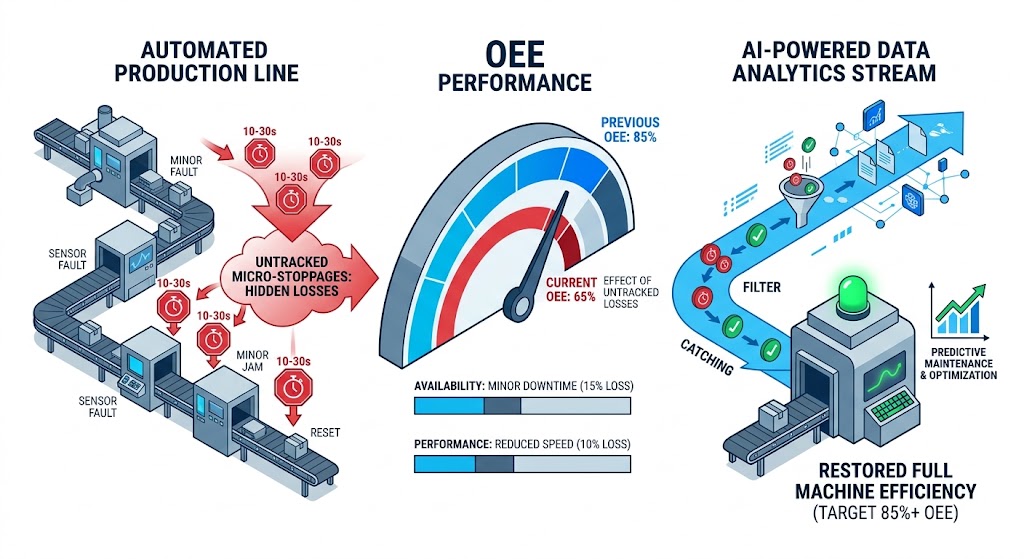
The real impact of micro-downtime on company OEE
In isolation, 30 seconds of machine downtime seems insignificant. However, when a plant accumulates 40 or 50 micro-interruptions per day for each workstation, the sum adds up to impressive cumulative erosion.
Industry research confirms the critical nature of the problem. According to studies published in ScienceDirect and McKinsey & Company’s analysis of digital manufacturing:
- In automated, high-speed lines, micro-stops (under 5 minutes) make up up to 70% of total stop events during a shift, but more than 80% of them go unrecorded if reporting is done by the operator.
- Adopting high-frequency automatic tracking and micro-data analytics can reduce overall downtime by 30% to 50%, unlocking immediate productivity gains.
Tracing a catastrophic 3-hour failure is simple and straightforward. Answering the question, “Why did Line 4 stop for 20 seconds 60 times during the night shift?” requires a technological and methodological paradigm shift.
Uncovering the Invisible: The Role of IoT, Data Analytics, and AI
To eliminate hidden losses, it is necessary to digitize and automate field data collection, completely eliminating reliance on manual reporting.
IoT and on-board machine connectivity
The first step is to collect data directly from the line PLCs or via IoT sensors attached to legacy machines. By capturing the “machine running/machine stopped” signal at millisecond intervals, the system records any micro-interruptions, without impacting the operator’s workload.
IoT Connectivity and Enterprise Asset Monitoring
The first step is to collect data directly from the line PLCs or via IoT sensors attached to legacy machines. By capturing the “machine running/machine stopped” signal at millisecond intervals, the system records any micro-interruptions, without impacting the operator’s workload.
Enterprise Asset Monitoring platforms like MATIX allow you to connect systems, monitor operating parameters, and correlate operating data with micro-downtime events. This way, field signals are transformed into predictive analytics and status indicators useful for preventative maintenance, allowing you to intervene before micro-outages turn into extended machine downtime.
AI algorithms and pattern recognition
Simply measuring isn’t enough: accumulating millions of micro-data points risks creating information overload. This is where Artificial Intelligence comes in. Pattern Recognition and Machine Learning algorithms analyze micro-stops, correlating them with:
- Specific batches of raw materials or supplies
- Special recipes or machine configuration parameters
- Environmental conditions (e.g. temperature or humidity in the processing tank)
- Work shifts or specific teams
This way, AI isolates recurring patterns and suggests targeted corrective actions before the micro-problem turns into a serious failure or permanent slowdown.
AI assistants and the digitalization of production
To eliminate information bottlenecks and data recording friction, modern lineside technologies integrate Generative Artificial Intelligence.
Solutions like Shopfloor AI act as a true virtual assistant for production. Operators can query the system or enter the reasons for a micro-downtime via an immediate, natural language conversational interface. This eliminates the time wasted manually compiling paper logbooks or complex reports, providing instant responses to those working on the line and making shift handover immediate, transparent, and traceable across all departments.
Frequently Asked Questions (FAQ)
How do I distinguish a micro-stop from a true speed loss?
A micro-stop involves a complete machine shutdown (zero line speed) resolved within a short period of time (usually under 5 minutes). Speed Loss, on the other hand, occurs when the machine continues to operate without stopping, but at a slower pace or cadence than the nominal design speed. Both negatively impact OEE, but require different corrective actions.
Is it necessary to replace PLCs or outdated machines to track micro-stops?
No. It is possible to apply edge computing solutions or non-invasive IoT modules that directly collect electrical signals or the status of signal lamps (light towers) without having to intervene on the PLC software or overturn the system’s original hardware.
How can Artificial Intelligence help prevent future micro-stops?
AI analyzes large amounts of historical and real-time data to identify correlations invisible to humans. For example, it can detect that a particular component begins to generate repeated micro-stoppages only when operating at a specific speed with a specific material, allowing the machine to be recalibrated before production suffers scrap or prolonged downtime.